Above Water 2022
Annual creative writing, art and multimedia anthology produced by UMSU Creative Arts and Media
The UMSU Media and Creative Arts offices are located on the land of the Wurundjeri People of the Kulin Nation. This land was stolen, and sovereignty was never ceded. Much work towards this anthology was also done remotely on unceded Indigenous land—the editors live on Wurundjeri land, and many submissions were written and crafted on Indigenous Country.We acknowledge the traditional owners of these lands, and pay our respects to their Elders, past and present. We extend this respect to all Indigenous readers and members of the University of Melbourne community. In compiling this anthology, we remember the very first storytellers and artists who lived on and cared for the land on which we make art. We thank First Nations contributors to this anthology, and urge non-Indigenous readers to seek out First Nations stories and art.
Above Water
Above Water is an annual creative writing and art competition hosted by the Creative Arts and Media Departments of the University of Melbourne Student Union (UMSU). Originally focused solely on creative writing, its scope has expanded over the years, and 2022 saw the introduction of a new multimedia category to celebrate works which transcend the printed page.Throughout the mid-year break, submissions trickled in from a range of University of Melbourne students. These were blinded by our fabulous editorial assistant and assessed by the editorial board, who put together a competitive shortlist—showcased in these pages—to present to the judging panel.The 2022 team included editors Marcie Di Bartolomeo, Nishtha Banavalikar, Prerna Aggarwal and Charlotte Waters; editor and designer Jasmine Pierce; and editorial assistant Rowan Burridge.This year’s winners were chosen by George Paton Gallery Director Sandie Bridie, 2021 writing co-winner Frankey Chung, and 2022 Union House Theatre Writer-in-Residence Melissa Reeves.
WINNER: BEST WRITING
No Fixed Address
by Nicole Davydova
illustrated by Jessica Norton
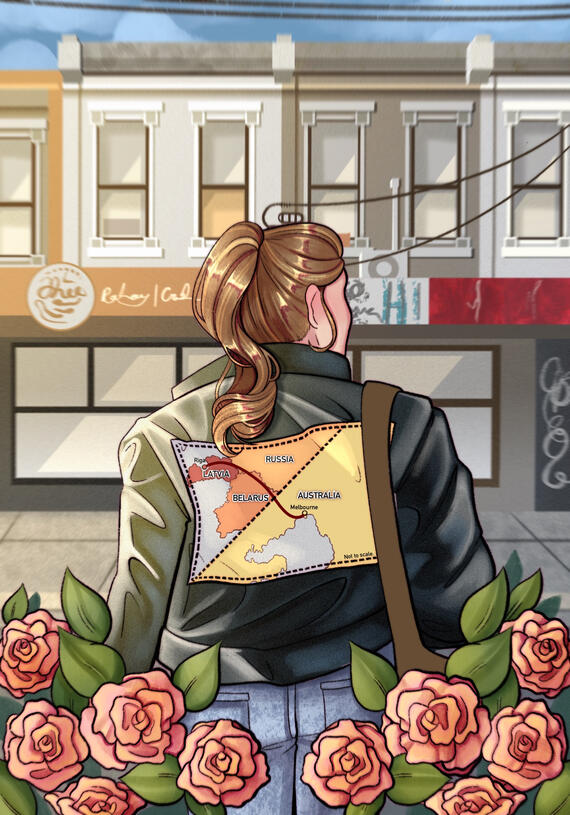
Content Warning: death of family members, homelessnessNote: This piece was written in April 2021.
The song begins with a steady drum, the thumping of a heartbeat. I watch my family roam around my grandmother’s kitchen. We have guests today, which warrants a table crammed with food, salads in crystal bowls, mushroom and egg blinchiki. The sun’s warm rays are streaming through the leaves of the lush Platanus tree out the front and the gold accents of the Khokhloma spoons beside the window appear to glow in the sunlight. The chorus sounds from my phone’s speaker and echoes around the kitchen. Everyone in the room knows the lyrics but no one sings along:Родина.
Еду я на родину,
Пусть кричат—уродина,
А она нам нравится…
Homeland.
I’m going to my homeland,
Let them shout—it’s ugly,
But we love it all the same…
The song is called ‘Родина’ (‘Homeland’) by the renowned Russian rock band DDT. An article
I read refers to them as the Rolling Stones of the USSR. My mother grew up on their music
during the turbulent Perestroika of the mid–late 1980s. As the second verse begins, I ask her
whether she agrees with the lyrics.“I’m not ready to talk about love towards my homeland at the moment, especially since I haven’t been there in a long time and don’t know if I like it.”My mother is a notorious critic of the USSR and current Russian government and spent countless days explaining Russian politics to me throughout my childhood. She always taught me that patriotism stems from a lack of critical thinking and tonight she seems adamant that I don’t take the lyrics to heart.“I don’t fully agree that you have to love it the way that it is, just because it’s your homeland. We should still be able to be critical and make complaints, okay?”My mother’s close friend is over for dinner and, as she enters the room, I invite her to join the discussion.“I was born in the Soviet Union.” She tells me how she was born to a Russian family in Riga, the capital of Latvia, but her family left when she was thirteen, after the republic gained its independence. “When people ask me where I’m from, sometimes I say Russia, and sometimes I say Latvia.”“It was my homeland which stopped being my homeland,” she says of Latvia.We continue to debate the difference between a homeland and a home, between patriotism
and nationalism. My grandma, who was born in Gomel, Belarus, says: “I can’t call Belarus my
homeland.” I ask her why not. My grandma is a well-read, intellectual woman and a hush falls
over the table as she speaks her mind:“You weren’t tied down [to your homeland],” she explains to me. “You were tied to your house, your street, your school, your friends. That’s it. But as a homeland? It was just a place where you lived. You moved, you lost your friends, everyone moved away. That’s it.That place doesn’t exist anymore.
Your house doesn’t exist anymore.
Your homeland doesn’t exist anymore.”
I wonder how it must feel for your homeland to stop existing.When I visited Russia for the first time in early 2020, my mother’s best friend from high school showed me the streets of Saint Petersburg where they grew up together. My grandmother’s university flatmate took me to the doughnut shop they used to visit after class. I walked the halls of my grandfather’s famous school on Nevsky Prospect. The familiar Russian tongue swirled in the frosty air around me and no one questioned my nationality. It felt like home.It’s the next morning, my grandma and I are standing side by side by the stove as she fries more blini, when I ask her what she meant when she said that she couldn’t call Belarus her homeland. “While mum was alive, you could say you were visiting your homeland and you were visiting your mum. I felt it immediately, the first time I went back after she was gone and I felt it immediately that you weren’t needed there anymore. Everyone has their life, everyone has their family. Your mum needed you. Of course everyone loves you, your brothers and sisters. Nonetheless, you were a guest, you weren’t coming home. As soon as my mum passed away these ties were broken.”As I listened to my recording of our conversation that day, it dawned on me that I knew that feeling.I used to live near my grandfather’s flat in Richmond. My primary school, our government housing apartment, his little flat, that strip of Victoria Street full of Asian grocers and butchers and restaurants with roast ducks hanging in the windows; that neighbourhood used to feel like home.Eventually, I changed schools, my mum and I moved to our own apartment in the north. But, as long as my grandfather lived in that same little flat, visiting him felt like coming home. When my grandfather passed away in 2020, his little flat was emptied by the Salvation Army, and my mum dropped off the key at the housing office. The tiny backyard was full of aromatic roses, which he had grown lovingly over the years. The first time I went back to Richmond without visiting his flat, the neighbourhood felt different. My last tie had been severed. It no longer felt like home.I am on the phone with Centrelink when the woman asks me if I’m homeless, since I haven’t
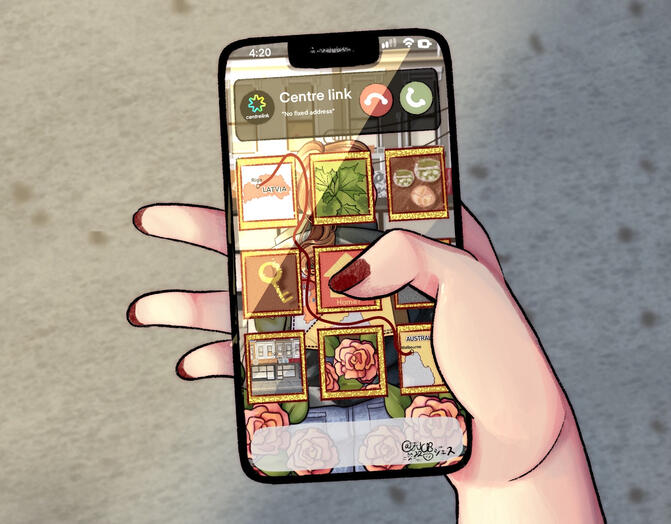
stayed at a residence longer than a month since November. Of course I’m not homeless, I wear my grandfather’s leather jacket, sleep beneath my mum’s paintings and hear my grandmother’s voice telling me to make my bed every morning. The woman marks me as having “no fixed address”.
WINNER: BEST POETRY
MUMSTRENGTH
By Harrison George
illustrated by Niamh Corbett
Content Warning: trauma, references to sex